Cyborg
Pitch
A pitch shifter for sounds that don’t exist yet. Slide between deterministic granular and alien spectral at any ratio. No phase smear. No random left channel. No mercy.
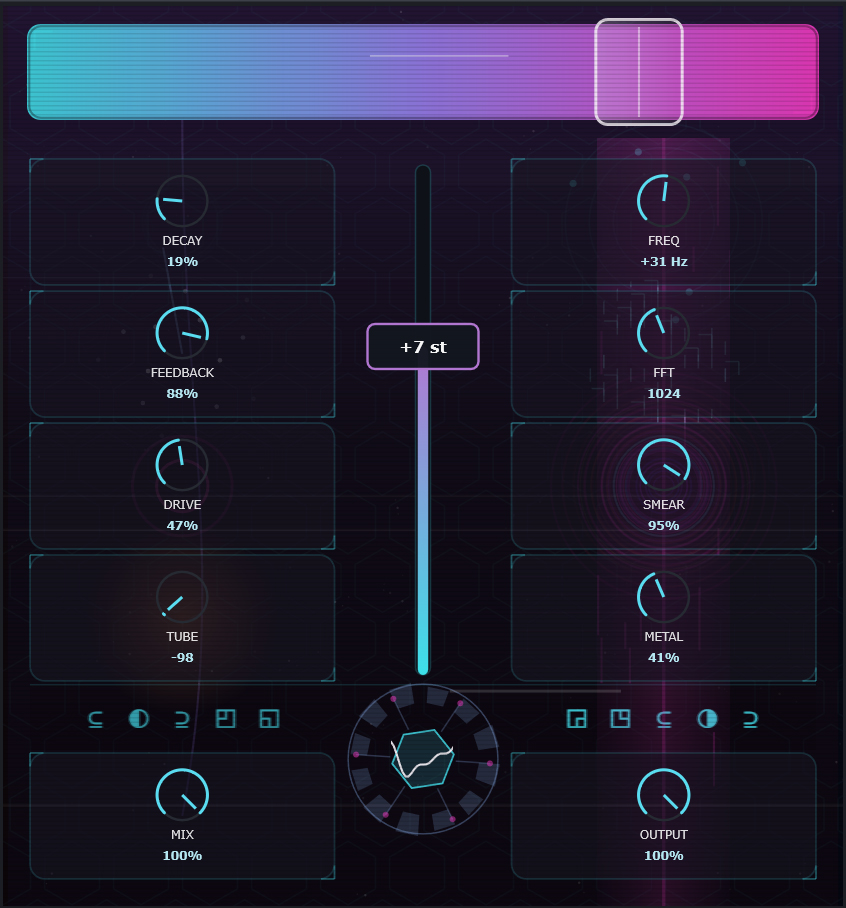
One algorithm is never enough
Phase vocoders destroy transients on percussive material — same kick, different random output every trigger. Granular engines can’t go full robotic. Bin-remappers click when you ask them to be musical. None of them let you be both at once.
Cyborg Pitch runs two completely separate engines in parallel and crossfades between them continuously. The CHARACTER knob is the whole instrument.
Two engines, always running
Character
Equal-power crossfade between both engines. Everything between is uncharted.
Every knob, explained
Details that actually matter
Transient recovery. Granular and spectral shifting smear attack transients by design. A post-blend TransientPunch stage re-sharpens every onset with a dual-speed envelope follower and HF soft-clip stabiliser — always on, at a fixed musical level. Kicks and snares still hit.
Latency alignment. The dry path tracks the active engine’s latency every block. At any FFT size the blend is phase-coherent and the host’s PDC compensation is exact. No ghost delays, no wet-dry slap.
Click-free bypass. Bypass crossfades over ~30 ms through the same processing path. No sample-jump, no click, no PDC discontinuity.
Get Cyborg Pitch
Two ways in. Pay with PSYKO on-chain for an instant download, or grab it through Patreon.